
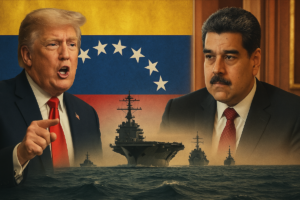
The moment Washington announced that Nicolás Maduro had been captured and that the United States would oversee Venezuela’s political transition and oil resources, the last remnants of the post–Cold War illusion collapsed.
It became then harder to deny what many strategists have been quietly concluding for years: the era of polite fictions is over. The world is slipping back into something older, colder, and far more dangerous.
For three decades after the Cold War, global politics was wrapped in the reassuring vocabulary of rules, institutions, and shared values. We called it the liberal international order—or, more confidently, Pax Americana. Borders would hold. Trade would pacify rivals. Great-power war would be irrational.
Today, that story no longer convinces even its authors.
The new U.S. National Defense Strategy (NDS) openly accepts what previous administrations tried to obscure: the world is once again divided into spheres of influence, and the United States intends to defend its own—forcefully, selectively, and without apology.
A Repartitioned World
Stripped of its bureaucratic phrasing, the NDS signals a return to imperial logic. The Western Hemisphere is framed as a core U.S. security zone. China is acknowledged as the central rival in Asia. Russia is treated less as a pariah than as a permanent great power with its own claims around Europe.
Most strikingly, the document is unusually critical of the European Union—not as a partner, but as a strategically weak, divided, and often obstructive actor. Europe appears less as a co-architect of global order and more as a dependency whose security problems Washington increasingly resents managing.
This is not the language of alliance. It is the language of hierarchy.
Europe and the Trump Doctrine
Donald Trump did not invent this worldview, but he expresses it with unusual clarity.
His repeated skepticism toward NATO, open hostility toward the EU, and transactional approach to allies stand in sharp contrast to his conspicuously soft rhetoric toward Vladimir Putin. While Ukraine is framed as a costly burden, Russia is often treated as a misunderstood peer—one whose “interests” deserve respect.
To many observers, Trump appears less committed to defending Ukraine’s sovereignty than to reaching an accommodation with Moscow, even if that accommodation comes at Europe’s expense. In a world of spheres of influence, Ukraine looks less like a frontline democracy and more like a bargaining chip.
For Europeans, the message is chilling: your security is negotiable.
If Russia dominates Europe’s eastern flank and the U.S. steps back—or selectively intervenes—then the post–World War II settlement collapses. The continent returns to being a buffer zone, not a partner.
Taiwan and the Erosion of the Silicon Shield
Nowhere is the gap between rhetoric and commitment more dangerous than in Taiwan.
For years, Taiwan’s semiconductor dominance—particularly through TSMC—has been described as a “silicon shield,” a strategic asset so vital that no major power could afford to see it destroyed or absorbed by China. This interdependence, the theory went, would deter invasion.
That shield is quietly weakening.
The construction of major TSMC facilities in Arizona, strongly encouraged by Washington, reduces the strategic cost of conflict. If cutting-edge chip production can be relocated—or at least partially duplicated—on U.S. soil, Taiwan becomes less indispensable and more expendable.
The U.S. continues to sell advanced weapons to Taipei—billions of dollars’ worth. Officially, this is deterrence. Unofficially, it looks increasingly like commerce without commitment.
Arms sales generate profit, signal concern, and avoid the one thing that really matters: a binding promise to intervene.
Would a second Trump administration actually go to war with China over Taiwan? The evidence suggests skepticism is justified. Taiwan may be strategically important, but it is also far away, risky, and inconvenient. In a world of spheres, it may already be penciled in as negotiable.
If Beijing concludes that Washington will protest loudly but act cautiously, the invasion of Taiwan stops being unthinkable—and becomes merely a question of timing.
Venezuela and the New Monroe Doctrine
Recent U.S. actions and statements regarding Venezuela—culminating in Nicolas Maduro capture and claims of direct control over the country’s political future and oil reserves—represent a dramatic escalation of hemispheric assertiveness.
Whether through military pressure, covert operations, or the language of outright intervention, the signal is unmistakable: the Americas remain a U.S. sphere of influence, and challenges to that status will not be tolerated.
This is not regime change dressed up as democracy promotion. It is strategic enforcement.
For Latin America, the message is familiar but newly blunt. The Monroe Doctrine is no longer an embarrassment to be explained away—it is policy again, openly and unapologetically, just with a different name: the “Donroe Doctrine.”
Greenland and the Logic of Empire
Trump’s earlier suggestion that the United States might acquire Greenland was widely mocked. In retrospect, it reads less like a joke and more like an unfiltered expression of imperial reasoning.
Greenland sits atop vast mineral resources, occupies a strategic Arctic position, and gains importance as climate change reshapes global trade routes. From an imperial perspective, sovereignty is secondary to utility.
The liberal order would never say this aloud. The new order does not bother pretending.
The End of Pax Americana
The tragedy is not just that this world is more violent. It’s that it is more honest.
Pax Americana rested on an illusion: that U.S. power could be both dominant and benevolent, imperial and principled. That illusion is gone.
What replaces it is a world of transactional alliances, selective outrage, and great-power bargaining over other people’s lives. Imperial wars return—not because leaders are irrational, but because the system once again rewards them.
Unless there is a dramatic domestic political reversal in the United States—one that recommits to alliances as partnerships rather than assets—the future looks grimly familiar. Borders will shift. Wars will be “managed.” Civilian deaths will be regretted, then forgotten.
History, it seems, was only sleeping.
And it has woken up angry.



Be First to Comment